...

7 Best Animatronic Western Dragon Manufacturers Worldwide

An Animatronic Western Dragon must do more than open its jaws or sweep its wings. It should feel like a creature with weight, intention, and a distinct personality. Watch the neck turn toward a visitor. Notice the pause before a roar. Small choices like these can make a display feel convincing—or oddly mechanical.

This guide explores seven manufacturers worldwide, comparing their experience, customization options, motion systems, materials, and ability to deliver reliable installations. A useful industry reference is Garner Holt, founder of Garner Holt Productions and a veteran animatronics builder. I could not verify a direct quotation from Holt about Western dragons, so I will not put invented words in his mouth. Instead, this editorial principle frames the comparison: “Every movement should reveal the creature’s character.” It is a design lens, not a sourced quotation.

The details matter. A buyer may need a dragon for a theme park, museum, retail attraction, or themed event. Each setting brings different demands for scale, control, maintenance access, and visitor interaction. A dramatic twenty-foot wingspan looks impressive, but only when the supporting structure and movement are thoughtfully engineered. Not every manufacturer excels at every scale. That deserves a closer look. The ranking considers visible craftsmanship alongside practical questions, such as service support and customization. Specifications can change between projects, so readers should confirm current capabilities directly with each manufacturer.
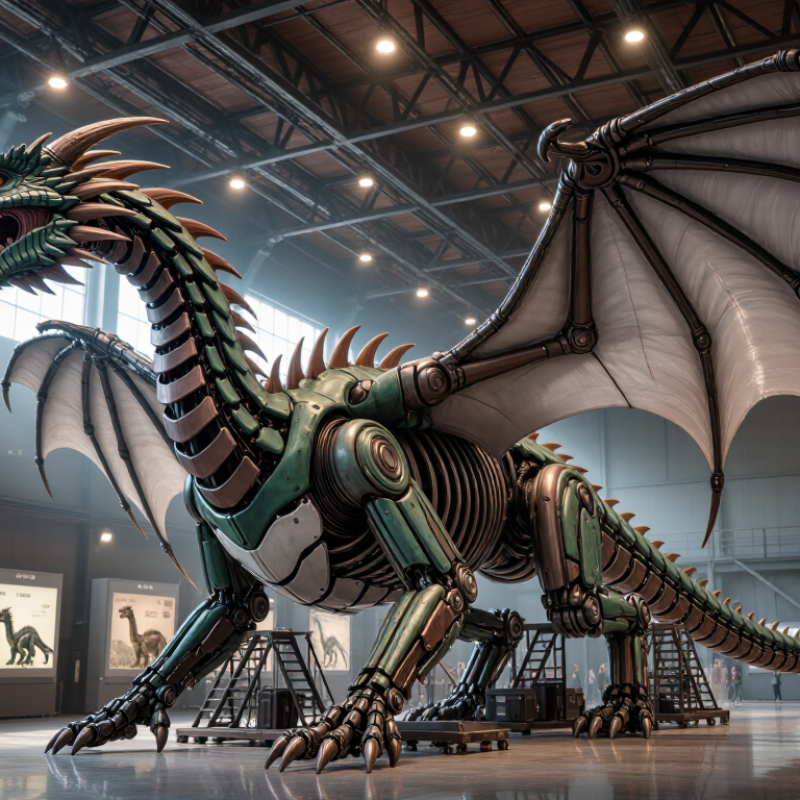
7 Best Animatronic Western Dragon Manufacturers Worldwide

How Western Dragons Are Classified by Scale, Degrees of Freedom, and Use

Western animatronic dragons are easier to compare when classified by scale, movement, and intended use. Small display figures may stand under one meter tall and suit shop windows or compact exhibits. Medium models often work well in themed interiors, where wings, jaws, and necks need room to move safely. Large outdoor figures can dominate a plaza, but their size brings practical demands: stronger supports, weather protection, and wider clearance.

Degrees of freedom describe how many parts move independently. A basic model may turn its head and open its mouth. More advanced designs can add blinking eyes, moving wings, a flexible neck, or a swishing tail. More motion can feel vivid, but it also adds controls and maintenance points. A mechanism that looks impressive in a showroom may behave differently after hours of repeated operation. That deserves a closer look.

Tips: Match the movement to the viewing distance. A small jaw motion may disappear across a large hall, while broad wing movement can overwhelm a narrow space. Ask for a motion list, operating cycle, and maintenance guidance before comparing models. Check floor space and overhead clearance, too. The categories are useful, not perfect; a medium dragon with carefully chosen movement may suit a venue better than a larger, more complex one.

Western Dragon Animatronics: Scale and Degrees of Freedom

Indicative planning ranges by approximate dragon height and typical display use

Degrees of freedom (DoF) are independently controlled motions, such as head turns, jaw movement, wing articulation, or tail motion. The ranges shown are illustrative design estimates, not an industry standard; actual configurations vary with mechanism, budget, and intended use. Compact and small units are often suited to tabletop or indoor displays, while larger builds are commonly designed for immersive exhibits or stage settings.

Which Motion, Payload, and Duty-Cycle Metrics Define Animatronic Performance?

An animatronic western dragon should be judged by repeatable movement, not dramatic poses alone. Ask for joint speed in degrees per second, travel range, and positioning repeatability. A slow neck turn can feel deliberate; a sudden stop may look mechanical. Check how the head, jaw, wings, and tail move together. Small details matter.

Payload figures need context. Ask how much weight each moving assembly supports, including coverings, lighting, and cables. A wing rated for a bare frame may behave differently once textured panels are fitted. Request test results at the finished load, and observe movement through the full range. Heat changes everything. Warm motors can slow down or trigger protective shutdowns, so a brief showroom demonstration is not enough.

Duty cycle describes how long the dragon can operate before rest or cooling is needed. Compare stated run time, rest interval, and expected daily starts with your actual schedule. Request repeated-cycle testing, not just one successful sequence. Also confirm whether ratings assume a cool indoor space. These metrics do not tell the whole story; noise, maintenance access, and smooth recovery after a stop matter too. It is easy to overvalue speed. A modest, steady motion may serve a display better than a fast one.

7 Best Animatronic Western Dragon Manufacturers Worldwide — Which Motion, Payload, and Duty-Cycle Metrics Define Animatronic Performance?

Use these seven measurable criteria to compare manufacturers. Animatronic dragon performance is project-specific, and there is no single industry-wide specification that makes one supplier universally “best.” Request test results for the exact configuration being quoted.

Performance Metric What to Specify How to Verify It Why It Matters for a Western Dragon
Motion axes and range List each controlled axis—such as neck yaw and pitch, jaw, eyelids, wings, tail, and body—and state its usable angular range in degrees. Distinguish independently controlled axes from mechanically linked motion. Review dimensioned drawings and a witnessed movement test. Confirm the stated range under the proposed skin, costume, cables, and other installed components. Axis count alone does not describe the performance. Range and independent control determine whether the dragon can produce the intended gestures without collisions or restricted movement.
Motion speed and profile Specify angular speed in degrees per second or linear speed in metres per second, together with acceleration, deceleration, and the intended movement sequence. Measure movement over time during a loaded test. Check for overshoot, abrupt starts or stops, and speed loss when the complete assembly is installed. A movement that is fast but jerky may look unnatural and increase mechanical stress. Smooth acceleration and repeatable motion are important for expressive performance.
Payload and load moment State the allowable load in kilograms at the specified mounting point and distance from the pivot. Request the permitted load moment in newton-metres where the load acts at a distance. Check calculations and test documentation for the actual mounting geometry. Confirm whether the rating includes the skin, props, cables, and any attached decorative parts. A payload figure without its mounting position can be misleading. A load farther from a joint creates a larger moment and can reduce speed, accuracy, or service life.
Position accuracy and repeatability Request position accuracy and repeatability in degrees or millimetres, with the measurement method, test load, and number of repetitions stated. Compare commanded positions with measured positions over repeated cycles. Ask whether results were recorded under the same load and operating conditions as the proposed installation. Repeatable jaw, eye, neck, and wing positions help animation cues stay synchronized with audio, lighting, and other show effects.
Duty cycle and cycle life Define the show schedule, movement sequence, operating time, rest time, and required cycles per day. Duty cycle is operating time divided by total cycle time, multiplied by 100%. Request a documented endurance test using the intended sequence and load. Record temperature, faults, maintenance interventions, and performance changes during the test. A mechanism that works briefly may not be suitable for repeated shows. Duty-cycle requirements should match the real schedule rather than an unspecified “continuous operation” claim.
Environmental protection Specify the actual environment: indoor or outdoor use, dust, moisture, temperature range, wind exposure, and cleaning method. Request an enclosure rating only where applicable. Check test documentation for any stated ingress-protection rating. IEC 60529 defines the IP Code used to classify protection provided by electrical enclosures; it does not, by itself, establish suitability for every outdoor condition. Outdoor displays and dusty venues can affect controls, connectors, bearings, and actuators. Environmental suitability should be confirmed for the complete installed system.
Safety, maintenance, and service access Document emergency-stop behavior, pinch-point safeguards, safe movement limits, inspection intervals, replaceable components, and access requirements for routine servicing. Review the risk assessment, wiring and maintenance documents, and a practical service demonstration. Confirm how the system stops and how it is made safe before maintenance. Large moving figures can create pinch, impact, and access hazards. Clear maintenance procedures and accessible service points support safer operation and reduce avoidable downtime.

Comparison note: Ask every bidder to provide the same units, load conditions, movement sequence, and test duration. Treat unverified ratings as unconfirmed; performance values should be tied to the specific dragon configuration and supported by documentation or witnessed testing.

Seven Worldwide Manufacturers Compared by Dragon Design and Production Strength

A fair comparison of seven worldwide animatronic dragon manufacturers should examine both visual design and production capability. Look closely at the head silhouette, horn placement, layered scales, and wing movement. These details determine whether a western dragon reads clearly from across a themed environment. Ask how makers translate sketches into full-scale models, then assess frame construction, actuator access, weather protection, and maintenance plans. Small jaw movements matter. So does a stable wing sweep.

Demand offers useful context, but not proof of dragon-specific sales. The TEA/AECOM 2023 Theme Index reported 244.6 million visits across the world’s top 25 theme parks, a 23 percent rise from 2022. That figure signals renewed investment in visitor experiences; it does not measure animatronic purchases. Compare each manufacturer’s documented production capacity, prototype process, installation support, and ability to match motion to a site’s space and audience. Request operating footage and service details, not only polished renderings. A polished head can still feel oddly lifeless. Even a technically strong build may need a better motion rhythm.

How IEC 60529 IP Ratings and DMX512-A Controls Shape Technical Selection

7 Best Animatronic Western Dragon Manufacturers Worldwide
How IEC 60529 IP Ratings and DMX512-A Controls Shape Technical Selection

For an outdoor Western dragon, an IP rating is a practical starting point, not a complete weather guarantee. Under IEC 60529, IP65 indicates dust-tight protection and resistance to water jets under specified test conditions. IP54 offers less dust protection and protection against splashing water. Check the rating of the actual motor housings, connectors, and control enclosures, not just the finished creature. Seams, cable glands, and condensation can still cause trouble. A high rating on one component does not rate the whole installation.

DMX512-A can coordinate lighting and cue-based effects across a show. Each universe carries up to 512 data slots, so confirm the dragon’s channel plan and controller compatibility before purchase. Ask how motion commands reach the mechanical controller; DMX is not, by itself, a motion-safety system. Verify cable termination, addressing, and the supplier’s documented test procedure. On paper, selection looks simple. In practice, unclear channel maps can slow setup.

Tips: Request the IP test scope in writing. Confirm which parts were tested, then review the DMX channel sheet with your integrator. Leave room for a controlled site test; specifications alone may not reveal every weak point.

How Lead Time, Warranty, and Lifecycle Cost Guide Manufacturer Selection

For animatronic western dragons, a quoted delivery date matters only if it includes design approval, fabrication, testing, crating, and shipping. Ask manufacturers to provide a dated production schedule with checkpoints, not just a number of weeks. A missed casting or control-system component can delay installation. McKinsey’s 2020 global value-chain report found that companies can expect disruptions lasting a month or longer about every 3.7 years. Build a buffer into opening plans. Three weeks may be enough—or not.

Warranty terms reveal how a manufacturer stands behind moving parts and electronics. Check coverage periods, exclusions, response times, and whether replacement components remain available. Ask what happens when a jaw actuator fails after repeated daily shows. Get the answer in writing. A long warranty is not useful if shipping a small sensor takes months.

Compare lifecycle cost, not just the initial quote. The U.S. Department of Energy’s lifecycle-cost method includes purchase, installation, energy, maintenance, replacement, and disposal costs. For a dragon, that means pricing routine inspections, control-system updates, spare actuators, and technician visits over its expected service life. Request a parts list and maintenance schedule. Then compare total costs across the same period. One awkward detail: estimates depend on operating hours, and those may change after opening. Be honest about that uncertainty.

Seraphinite AcceleratorOptimized by Seraphinite Accelerator
Turns on site high speed to be attractive for people and search engines.