...

7 Tips for Buying Rock Wool Sandwich Panels?

Buying a rock wool sandwich panel is not simply a price comparison. It is a decision about fire safety, thermal stability, moisture control, and installation risk. The 2024 Global Status Report for Buildings and Construction, published by UNEP and GlobalABC, reports that buildings consume about 32% of global energy and produce approximately 34% of global carbon emissions. Better envelope design matters.

John Straube, a respected building-science expert, often emphasizes this principle: “Control heat, air, and moisture.” It sounds simple. On a real project, however, a 100-millimeter panel, a damaged joint, or a poorly sealed flashing can change the result. This guide examines seven practical buying points, including core density, fire classification, thermal conductivity, panel thickness, joint design, certification, and supplier support. EN 14509 compliance should be checked where applicable. Fire ratings should also match the building’s use and local requirements. A datasheet alone is not enough.

FM Global guidance and European fire-safety practice both underline the importance of tested assemblies, not isolated materials. That distinction is easy to miss. Buyers should request test reports, factory quality records, coating specifications, and installation details. Cost still matters, naturally, but the cheapest panel may create higher maintenance costs later. No checklist is perfect. Site exposure, condensation risk, transport damage, and installer skill can still surprise an experienced buyer. These seven tips aim to reduce those surprises and support a more evidence-based purchase.
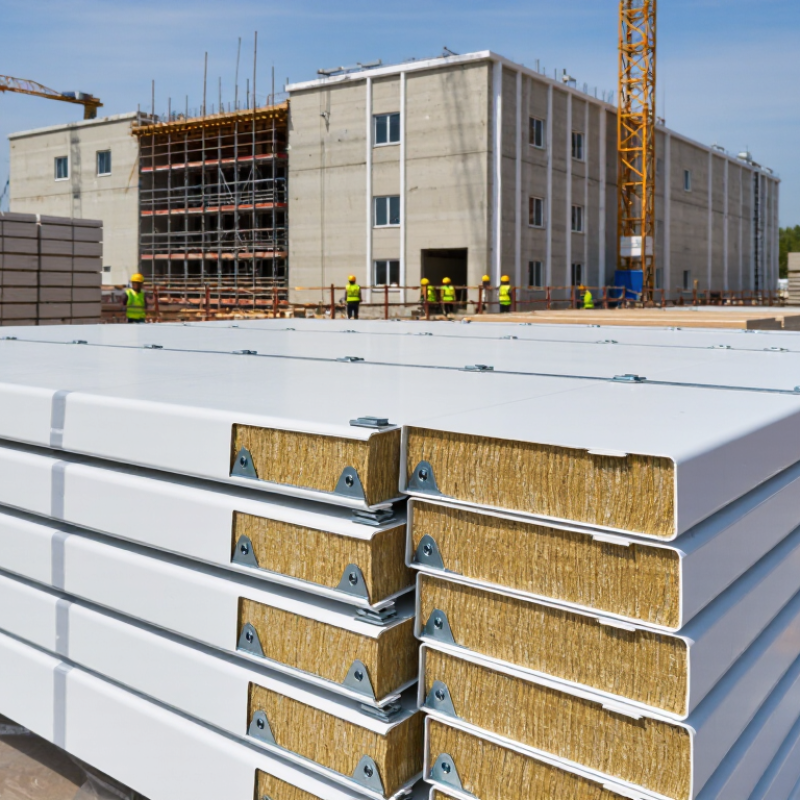
7 Tips for Buying Rock Wool Sandwich Panels?

Define Panel Needs: Use, Span, U-Value Targets, and Fire Class

Before buying rock wool sandwich panels, define the building’s real duty. Is it a warehouse wall, cold-room envelope, roof, or fire-rated partition? Record the clear span, support spacing, wind pressure, snow load, internal temperature, and expected impact. A 100 mm panel may suit a short wall, but it can deflect across a longer bay. Check the manufacturer’s load tables and EN 14509 design data, not thickness alone. Measure twice. Do not guess.

Set a U-value target from the local climate and energy model. The IEA reports that buildings consume about 30% of global final energy, so weak envelope choices can create years of avoidable heat loss. Compare declared thermal transmittance, joint details, fixings, and thermal bridges under ISO 6946 principles. Rock wool cores often provide strong fire performance, but the complete assembly must be tested. Under EN 13501-1, some mineral-wool systems can achieve A1 or A2-s1,d0 classifications; the exact result depends on facings, adhesives, joints, and penetrations. Ask for the test report and scope.

Fire class should match the building’s risk, occupancy, escape routes, and local code. A panel marketed as “non-combustible” may still fail at an unprotected joint. That detail matters. Review reaction-to-fire data, fire-resistance minutes, smoke development, and fixing behavior. An imperfect specification is still better than a confident assumption. Industry guidance from EN 14509, EN 13501-1, and national fire authorities should support the final selection.

Compare Core Specs: 80–150 kg/m³ Density and 0.035–0.045 W/m·K λ

7 Tips for Buying Rock Wool Sandwich Panels

The core specification deserves more attention than the panel surface. Common rock wool cores range from 80 to 150 kg/m³, while declared thermal conductivity typically falls between 0.035 and 0.045 W/m·K. Lower λ usually means better insulation, but testing temperature and moisture can change the result. ASHRAE Handbook—Fundamentals notes that insulation conductivity varies with temperature, density, and humidity. Therefore, compare declared values under the same test conditions.

Tip 1: Request the test temperature and moisture condition. Tip 2: Check whether density is measured across the full core or only one section. Tip 3: Match the λ value with the required U-value, not marketing language. EN 13162 covers mineral wool insulation characteristics, while EN 14509 addresses factory-made sandwich panels. These references help verify declared performance.

Density also affects handling, acoustic behavior, fire performance, and structural stability. A 150 kg/m³ core is not automatically the best choice. It may add weight and installation effort. An 80 kg/m³ core may reduce cost, yet perform differently under compression or fire exposure. I once saw a specification choose the lowest λ without checking joint leakage. That was a costly oversight. Inspect tongue-and-groove details, panel thickness, fasteners, and edge sealing. Ask for fire-test classification, dimensional tolerances, and production quality records. Test data matters more than a polished brochure.

Check Fire Safety: A1 Noncombustibility and Tested Panel Assemblies

7 Tips for Buying Rock Wool Sandwich Panels?

Fire performance should lead your buying decision. A1 under EN 13501-1 means the tested product is non-combustible under that classification system. It does not automatically make a complete wall fire-rated. NFPA reported about 37,910 industrial and manufacturing structure fires annually in the United States from 2017 to 2021. The same report recorded approximately $1.2 billion in annual direct property damage. Those figures make small construction details matter.

Tip: Request the full fire-test report, not only an A1 certificate. Check the tested thickness, density, joint design, core orientation, fasteners, and support structure. These details must match your proposed installation. Ask whether the report covers the entire panel assembly, including horizontal joints, corners, doors, penetrations, and service openings. A perfect core can still fail around a poorly sealed cable route. It happens.

Tip: Verify the fire-resistance period separately. A1 describes reaction to fire, while 30, 60, or 120 minutes describes resistance performance. The European classification framework EN 13501-2 evaluates load-bearing capacity, integrity, and insulation. Do not treat these terms as interchangeable. Request evidence from an accredited laboratory and confirm the report’s field of application. If your design sits outside that scope, obtain an engineering assessment before ordering.

Tip: Inspect installation quality. Keep mineral wool edges tight, use approved joint seals, and record every penetration. Site photographs help, although photographs cannot replace inspection. I would also compare the specification against local building requirements and the insurer’s guidance. Product literature is useful, but tested assemblies are more trustworthy.

7 Tips for Buying Rock Wool Sandwich Panels? – Check Fire Safety: A1 Noncombustibility and Tested Panel Assemblies

Tip Buying Check What to Verify Relevant Standard or Evidence Why It Matters
1 Confirm the reaction-to-fire classification Request the official classification for the mineral wool core and the complete panel product. An A1 classification indicates the tested product is non-combustible under the applicable European classification system. EN 13501-1; classification should be supported by an appropriate declaration, assessment, or test documentation. A core classification alone does not automatically prove that the finished sandwich panel or its joints have the same fire performance.
2 Ask for tested panel-assembly results Check whether the exact wall or roof assembly has been tested, including panel thickness, steel facings, joint design, fasteners, seals, supports, and installation orientation. Fire-resistance testing is commonly assessed using EN 13501-2 with test methods such as EN 1364-1 for non-loadbearing walls or EN 1365-1 for loadbearing walls, where applicable. Fire performance belongs to the complete construction assembly, not only to the insulation material.
3 Check the required EI or REI rating Match the project requirement to the documented rating. E represents integrity, I represents insulation, and R represents load-bearing capacity. Examples include EI 30, EI 60, or another project-specified period in minutes. The required rating depends on the building design and local regulations. An A1 reaction-to-fire classification does not by itself establish a 30-, 60-, or 90-minute fire-resistance rating.
4 Review the core construction and density Verify the mineral wool type, nominal density, fibre orientation, lamella or standard-board construction, thickness, and compressive strength stated in the technical documentation. Mineral wool products are commonly evaluated against product standards such as EN 13162, while the exact requirements depend on the product type and intended use. Density and fibre orientation influence thermal, acoustic, mechanical, and fire performance; they should not be used as a substitute for a fire test report.
5 Inspect the joints, penetrations, and accessories Confirm the approved joint geometry, sealants, fire-resistant strips, flashing, fasteners, openings, service penetrations, and perimeter details. Require installation details that correspond to the tested or assessed configuration. Any deviation should be reviewed by the responsible fire engineer or competent authority. Gaps, unsealed joints, combustible inserts, or untested penetrations can reduce the fire performance of an otherwise suitable panel system.
6 Compare thermal performance using declared values Compare the declared thermal conductivity, panel thickness, thermal transmittance, and thermal-bridge details. Do not compare thickness alone. Thermal conductivity is normally expressed in W/(m·K), and thermal transmittance in W/(m²·K). The declared values should be taken from the product technical documentation. A thicker panel generally provides greater thermal resistance, but joints, fixings, moisture, and installation quality also affect the completed wall or roof.
7 Verify documentation, compliance, and installation limits Collect the declaration of performance where applicable, product data sheet, fire classification report, fire-resistance report, installation manual, storage instructions, and permitted spans or loads. Check compliance with the project specification, applicable building regulations, and relevant product or structural standards. Confirm that the report covers the proposed panel thickness and support spacing. Correct documentation helps the designer, inspector, and installer confirm that the supplied panels match the approved design.
Important: A1 non-combustibility describes reaction to fire under the relevant classification system. It is not the same as the fire-resistance rating of a complete panel assembly. Always verify the exact tested configuration and local regulatory requirements.

Validate Durability: Coatings, Corrosion Protection, Joints, and Load Data

When buying rock wool sandwich panels, durability begins with evidence, not attractive color charts. During site inspections, I check coating thickness, edge coverage, and exposed cut lines. A panel can look flawless while moisture enters through one unsealed incision. Ask for coating specifications, test results, and the intended exposure category. Salt air, factory fumes, and frequent washing require different corrosion protection.

Rust starts quietly. Examine fasteners, washers, flashings, and panel edges together. Dissimilar metals can accelerate corrosion at wet joints. Confirm sealants remain compatible with the coating and insulation core. Inspect joint geometry, compression, and drainage paths before approving installation. Tight joints are not automatically watertight. Poor alignment can crush edges and leave narrow gaps. Do not guess. Request installation tolerances and repair procedures for damaged surfaces. A small field repair may prevent a large replacement later, though temporary touch-ups are not always durable.

Load data deserves the same scrutiny as coating claims. Request tested spans, wind pressures, impact resistance, and allowable deflection. Check whether values apply to the exact thickness, core density, joint profile, and support spacing. Do not rely on a single headline load number. Temperature, moisture, openings, and repeated loading can change performance. Have a qualified engineer verify the design against local requirements. One weakness in this buying process is trusting laboratory data without examining site conditions. I would also photograph delivered panels, labels, packaging damage, and joint samples. That record makes later quality discussions clearer and fairer.

Audit Suppliers: Certifications, Factory QA, Installation, Warranty, and Cost

7 Tips for Buying Rock Wool Sandwich Panels?

Audit the supplier before comparing panel prices. Request current certificates for fire performance, thermal conductivity, density, and structural strength. Check whether an accredited laboratory issued each report. The certificate should match the exact panel type, thickness, and core density. Ask for batch records and production dates. Ask for the evidence.

A reliable factory should explain its quality controls without hesitation. Inspect records for thickness checks, adhesive coverage, bond strength, surface flatness, and dimensional tolerance. Factory photographs help, but a live inspection provides stronger evidence.

During installation, confirm trained crews understand joint sealing, fastener spacing, flashing, and moisture protection. Small gaps can create cold bridges and water problems. Installation errors are often blamed on the panel.

Review the warranty line by line. Confirm coverage periods, response procedures, exclusions, and responsibility for replacement labor. Request references from projects using similar climates and building loads.

Compare the complete cost, including transport, accessories, installation, testing, maintenance, and possible delays. Cheap quotes can mislead. I once focused too heavily on the lowest material price and overlooked missing trims. That decision increased labor costs and extended the schedule.

A written quotation should identify every assumption, not hide it in technical language. Suppliers who answer specific questions clearly are easier to trust when problems appear.

Article Source:

Seraphinite AcceleratorOptimized by Seraphinite Accelerator
Turns on site high speed to be attractive for people and search engines.